



Threat intelligence analysts and builders. Talk to someone who does this work, and get a straight answer.
Contact usGet a DemoStart a free trial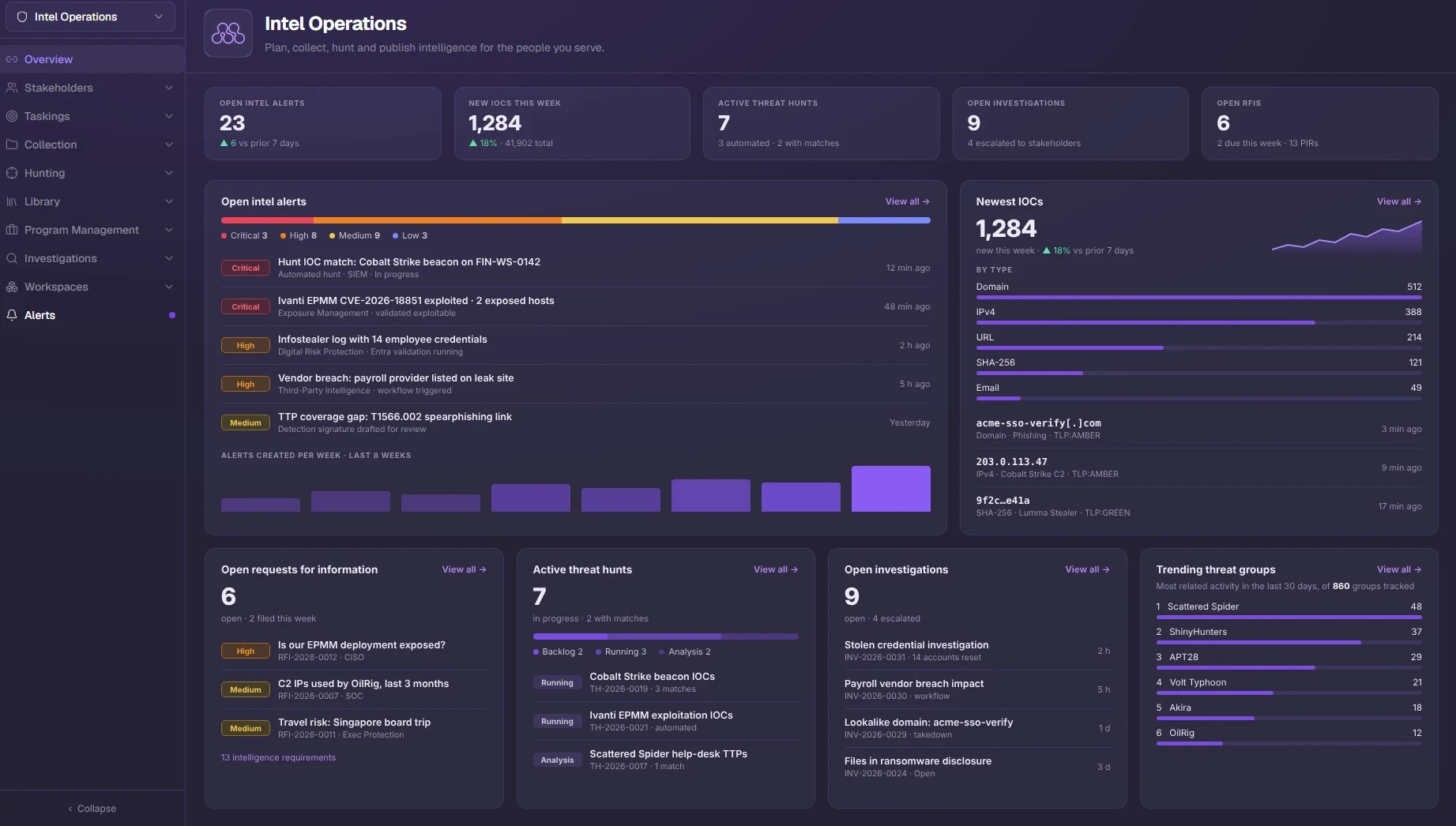
What Intel Operations covers.
Threat Intelligence Platform
Intelligence from external feeds, threat reports, trusted communities, partners and your own security findings comes together in one consistent record, and indicators are managed through their full lifecycle.
- Indicators standardized and deduplicated, keeping their sources, timestamps, context and handling restrictions
- Validation, enrichment, correlation and analyst assessment, with confidence, freshness, relevance and source reliability
- Decide what each indicator is for: research, enrichment, monitoring, hunting, alerting or blocking
- Approved indicators distributed to SIEM, endpoint, network, DNS, web and email controls through supported integrations, APIs or feeds
- Indicators updated, suppressed, revoked or expired as evidence changes, with delivery status from each integration
- STIX 2.1 ingestion and export. Already have a TIP? Use Morado alongside it and consolidate later if you choose
Stakeholders & Requirements
Intelligence starts with the people who need it. Stakeholder profiles connect each audience to its mission, interests, reporting preferences and sharing permissions, and Priority Intelligence Requirements turn their concerns into focused questions.
- Which threat actors target our sector, and which of their techniques matter in our environment?
- How are attackers bypassing the identity and security products we rely on?
- Where do we lack detection coverage for the threats most likely to affect critical operations?
- PIRs with owners, priorities, review dates and criteria for when a question is answered
Requests for Information
A structured way for stakeholders to ask for support, and for analysts to ask stakeholders for context.
- The question, context, decision to support, urgency, deadline and handling restrictions
- Assigned, tracked and linked to requirements or investigations
- Answers delivered with evidence, remaining uncertainty and recommended actions
- Recurring requests reveal the need for a standing requirement or report
Planning Board
Plan collection, assign investigations, schedule reports, coordinate hunts and track detection work, each connected to the requirement or request that explains why it exists.
- Owners, priorities, deadlines, dependencies and status in one view
- Balance planned research with urgent operational requests
- Spot requirements that are not getting enough attention
Investigations
A structured place to collect evidence, develop and test hypotheses, and document conclusions, starting from an RFI, an alert, a new campaign, an IOC match or a coverage gap.
- Reports, observables, indicators, entities, timelines, relationships and hunt results on one canvas
- What is known, what remains uncertain, and which explanations are being considered
- Conclusions separate observed facts from analytical judgment, with confidence and limitations
- Findings become reports, indicators, hunts, detection requirements or new RFIs
Retrospective Hunting
Use newly available intelligence to search historical activity in your environment through connected security tools, and answer the question: have we already seen this?
- Hunts from an investigation, report, actor profile, technique or coverage assessment
- Hypothesis, scope, time range, queries, findings and disposition kept together
- A hunt with no matches is recorded with its limitations, so absence of results is not mistaken for proof
Threat Coverage Across Frameworks
Map the behaviors of actors targeting you, your peers and the products you depend on, then check them against your telemetry, controls, detections and validation evidence.
- MITRE ATT&CK (Enterprise, ICS, Mobile), ATLAS and CAPEC
- Fraud frameworks: Stripe FT3 and MITRE Fight Fraud Framework (F3)
- AI security: OWASP AI projects, NIST adversarial ML taxonomy, Cisco AI Defense taxonomy and Google SAIF
- Browser and identity attack taxonomies
- Coverage recorded as validated, partial, untested, missing or not applicable, with evidence attached
Coverage Gaps to Detections
Turn identified gaps into detection work, with generated signatures and queries tailored to your tools and tied to the threat and evidence behind them.
- Required data sources, expected behavior, assumptions, false positives and validation criteria
- Your analysts and detection engineers review, test, tune and deploy
- Gaps are reassessed after deployment, and gaps a signature can't close become logging, control or research tasks
Reporting & Feedback
Intelligence products tailored to their audience, connected to the requirements they answer, with feedback that becomes follow-up work.
- Operational reports with indicators, techniques, queries and response guidance
- Leadership reports on impact, exposure, confidence and priorities
- Stakeholders rate relevance, timeliness and usefulness, ask questions and report actions taken
- Feedback refines requirements, opens RFIs or reopens investigations
Workspaces & Sharing
Controlled spaces for chat and intelligence collaboration among authorized stakeholders, and between organizations that agree to connect, in an ISAC-style model of trusted exchange.
- Separate groups for audiences, missions, investigations or requirements
- Share selected intelligence; membership, permissions and sharing restrictions define access
- Partner sightings and corrections inform your assessments, keeping their source and handling requirements
Threat Actor Knowledge
Morado's threat actor knowledge base gives context on actors, their recent indicators, their techniques and the vulnerabilities they leverage.
- Supports research and automated investigations
- Connects external threat activity with checks of your own environment
Morado AI
Investigate how reported threats relate to your actual environment. Using platform data and connected sources, Morado AI helps assess relevant technologies, exposure and defensive coverage, and recommends how to defend.
- Supporting evidence stays visible
- Recommendations tied to your technologies, exposure and coverage
Measuring Outcomes
Connect intelligence activity to outcomes: requirements answered, RFIs resolved, reports reaching the right people, hunt findings, indicator delivery, false positives, coverage gaps and validated detections.
- Built-in CTI-CMM assessment to see where the program stands and track progress
- Stakeholder feedback shows whether intelligence is useful
Intel Operations in practice.
A relevant news story
- News Stream brings related reporting into one story and extracts IOCs, vulnerabilities, TTPs, threat actors and third parties.
- An analyst uses Morado AI and connected platform capabilities to assess relevance to the organization.
- Findings lead to hunts, coverage assessments, exposure checks and recommendations.
A third-party breach
- Third-party monitoring identifies an incident.
- A workflow investigates the actor, hunts for indicators, checks TTP coverage and examines relevant vulnerabilities.
- Relevant findings are escalated to the teams responsible for action.
An executive trip
- Intel Operations captures stakeholder questions.
- Digital Risk Protection contributes relevant exposure. Physical Security contributes destination reporting and geographic context.
- Analysts deliver an assessment. Stakeholders review it, give feedback and open RFIs.
Intelligence that answers the questions your stakeholders ask, improves your defenses, and shows its impact.
Software and analyst expertise, together.
See Morado in action.
Book a demo and see Morado built around your organization: your exposure, your threats and the workflows to act on them.
Questions first? Contact us.