
Threat intelligence analysts and builders. Talk to someone who does this work, and get a straight answer.
Contact usGet a DemoStart a free trial

Four modules. One platform. Take the tour.
 Click to enlarge
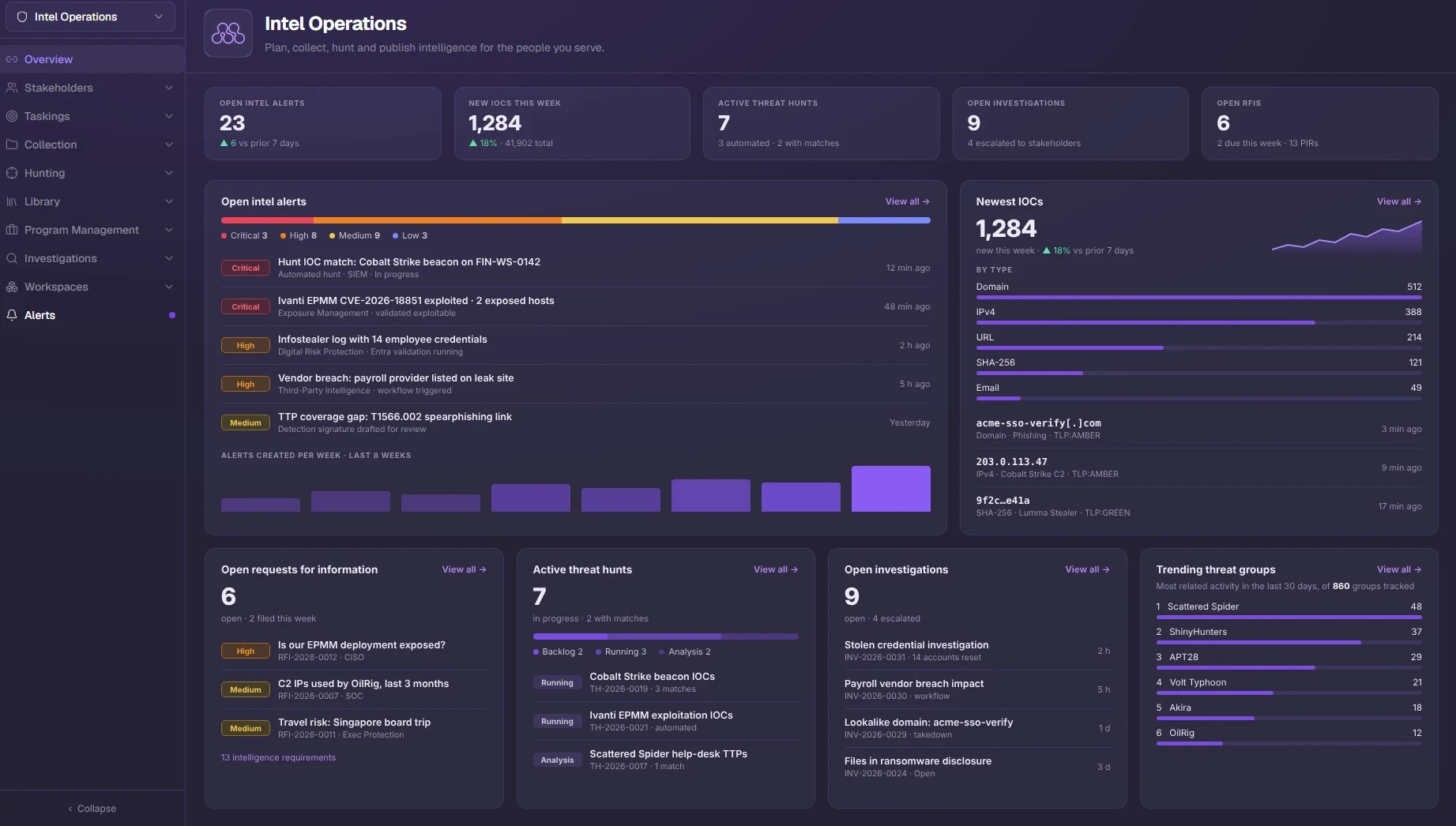
Intel Operations connects the entire intelligence lifecycle, from what stakeholders need to know, through collection and investigation, to defensive action, reporting and feedback. At its core is a full Threat Intelligence Platform. Around it are the requirements, hunts, coverage analysis, detections and reporting that turn intelligence into decisions and better defenses.
 Click to enlarge
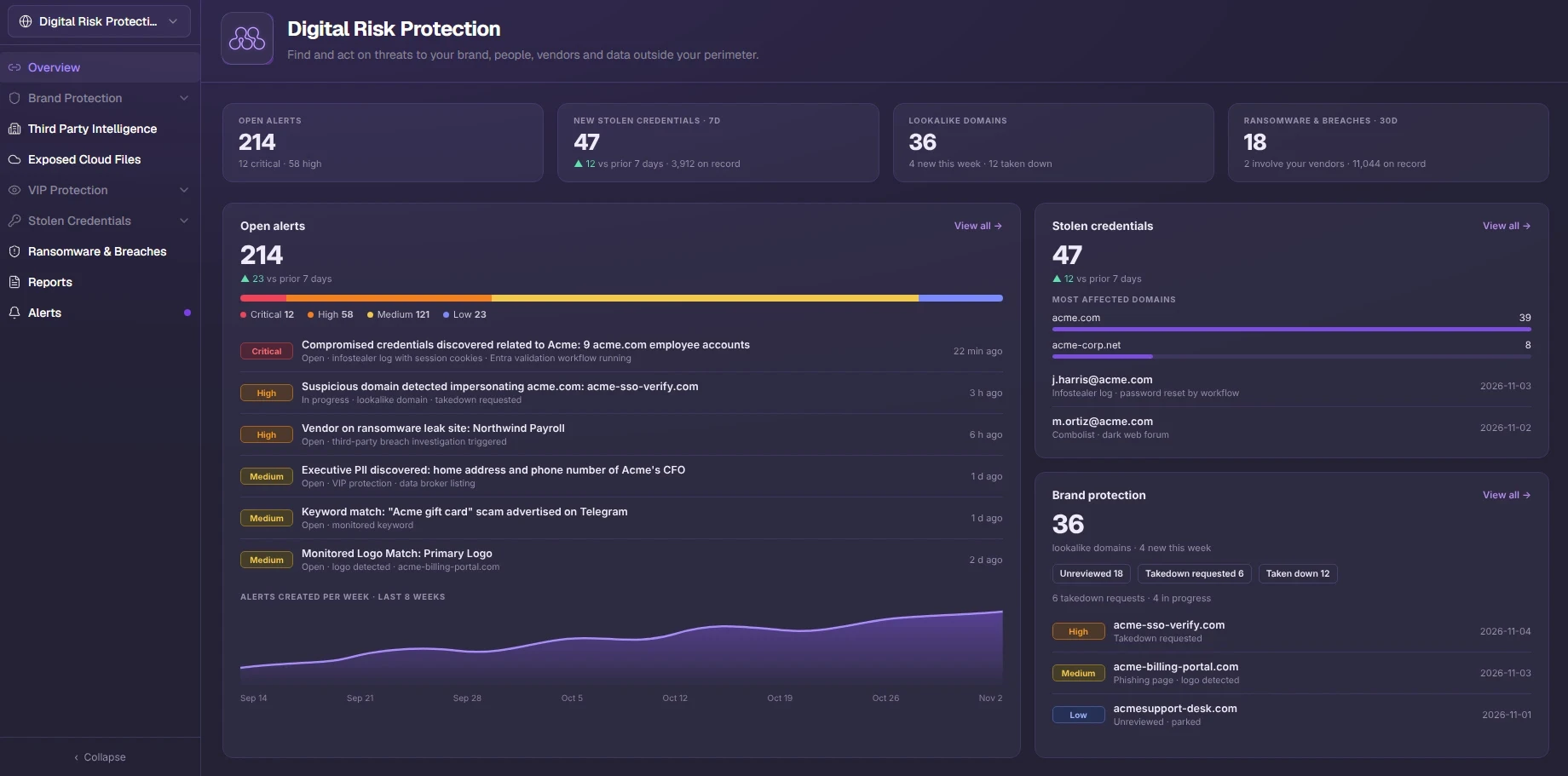
Digital Risk Protection identifies external threats and exposures affecting your organization, its people, its brand and its business relationships. It connects impersonation, exposed information, compromised credentials, third-party risk and breach activity with investigation and remediation, so findings keep their evidence and turn into prioritized action.
 Click to enlarge
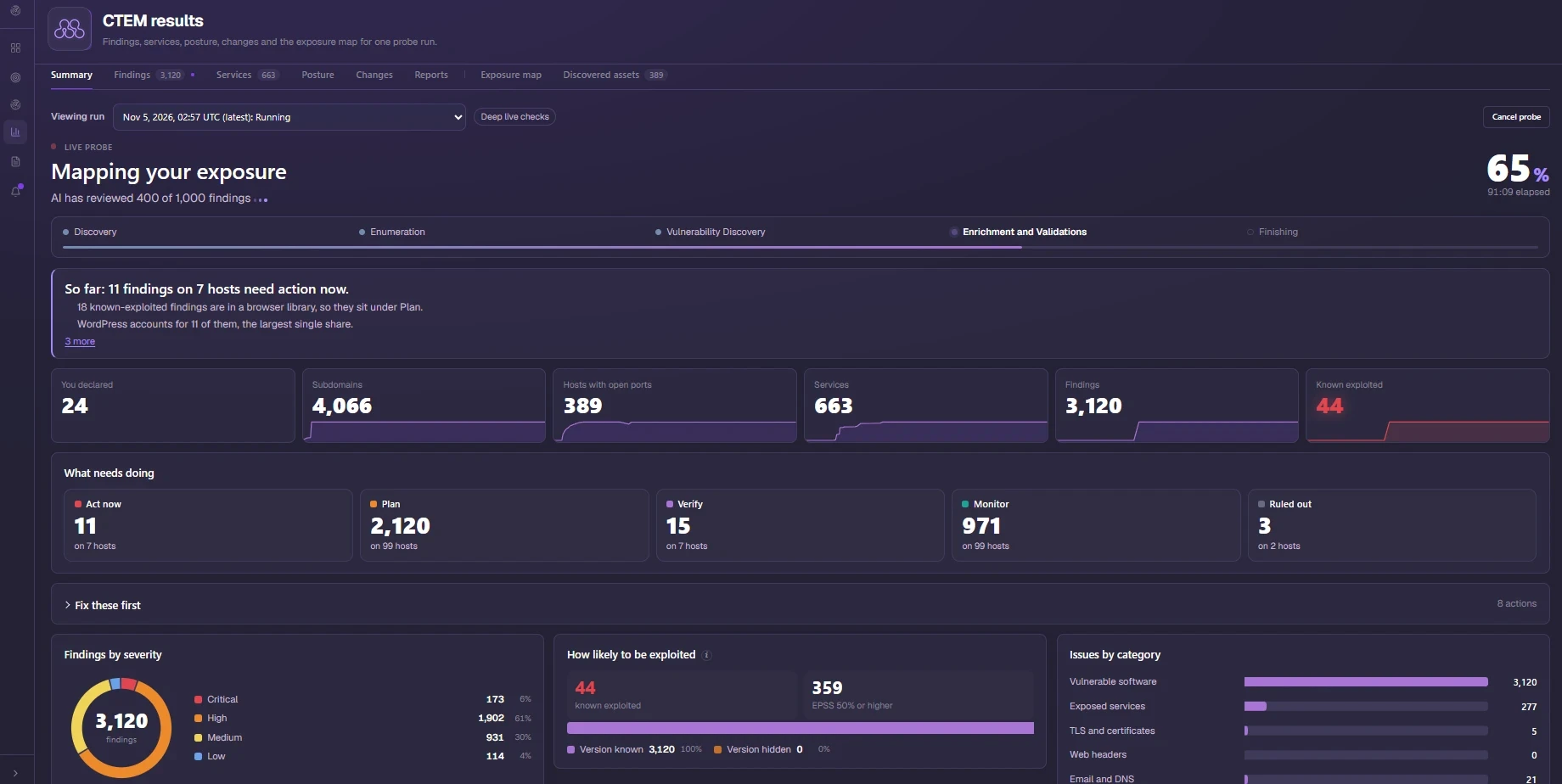
Exposure Management discovers your exposed assets, identifies weaknesses, validates exploitability and prioritizes remediation by the threats that matter to you. It supports a full Continuous Threat Exposure Management (CTEM) program, connecting discovery, threat intelligence, live validation, drift monitoring and stakeholder notification, so you know what is exposed, what changed, what attackers could exploit, and what to fix first.
 Click to enlarge
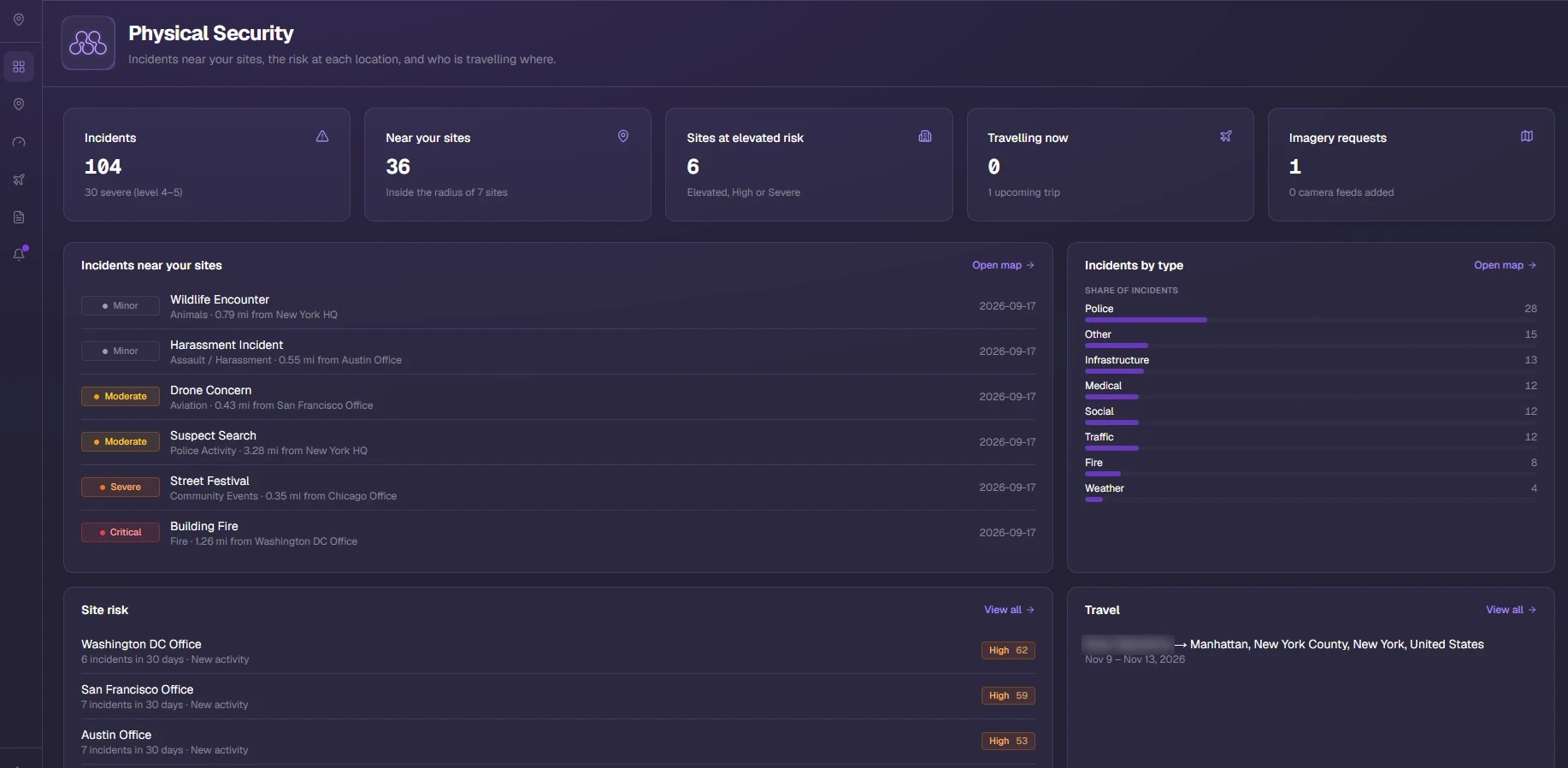
Physical Security monitors physical threats that could affect your employees, your travelling executives and VIPs, and the places where your people work. It connects location-based monitoring, travel risk, camera integration and geopolitical intelligence, so security teams know what is happening, who or what may be affected, and who needs to act.
Why security teams choose Morado.
Requirements, research, digital risk, exposure, physical risk and reporting in one platform, so findings connect instead of sitting in separate tools.
- Four modules, one record of what was found and why it matters
- Findings flow into cases, workflows, reports and RFIs
- Tasks in Morado or synced to ServiceNow
Morado makes its own intelligence and exposure data and pulls in your feeds and scanners. No rip and replace.
- 50+ integrations: SIEM, EDR, CTEM, vulnerability
- Your scanners and TIP complemented, not replaced
- Four modules in one platform, not separate tools
Analysts get productive fast. Morado works out of the box, without the months of set-up a TIP needs, and feeds IOCs to your SIEM.
- Threat profile set up in about a minute
- Live feed from industry and community sources
- Morado AI answers "does this apply to me?"
Run it yourself, have Morado's analysts run it with you, or have it fully managed. AI speeds up collection and triage, and your analysts make the call.
- Self-serve, with analysts, or fully managed
- Analyst-validated findings and reports
- RFI responses and dark web investigations
Built-in CTI-CMM tracking shows where your program stands and what to fix next, and gives leadership a clear before and after.
- CTI-CMM maturity view and trend line
- Next steps to raise your maturity
- A board-ready before and after
One platform, from the first signal to the people who act.
Intelligence, findings and actions move between modules instead of sitting in separate tools. A few examples:
A relevant news story
- News Stream brings related reporting into one story and extracts IOCs, vulnerabilities, TTPs, threat actors and third parties.
- An analyst uses Morado AI and connected platform capabilities to assess relevance to the organization.
- Findings lead to hunts, coverage assessments, exposure checks and recommendations.
A compromised credential
- Digital Risk Protection identifies an exposed credential.
- A workflow checks the account through the Microsoft Entra integration and performs the configured validation and protection actions.
- The user is notified.
A third-party breach
- Third-party monitoring identifies an incident.
- A workflow investigates the actor, hunts for indicators, checks TTP coverage and examines relevant vulnerabilities.
- Relevant findings are escalated to the teams responsible for action.
An executive trip
- Intel Operations captures stakeholder questions.
- Digital Risk Protection contributes relevant exposure. Physical Security contributes destination reporting and geographic context.
- Analysts deliver an assessment. Stakeholders review it, give feedback and open RFIs.
A shared community finding
- An organization shares intelligence in a Workspace.
- Other participants add context and discuss its relevance.
- Teams use the intelligence in their own investigations and defensive work.
Across every module: Alerts · News Stream · Agentic Workflows · Stakeholder Accounts
Software and analyst expertise, together.
Reasons to trust us.
Built by CTI practitioners
Designed by people who have run threat intelligence programs, not by a product team guessing at the workflow.
SOC 2 Type II audited
Our security controls are independently audited. Request the report from our Trust Center.
Used by our own analysts every day
Our analysts run customer programs on the same platform you use, so what we ship is tested in real work.
AI that answers to people
Morado AI answers from your organization's own data, and anything that would change data waits for a person to confirm it.
Your data stays yours
Your organization's data lives in its own isolated environment, and you control who can see it.
Veteran-owned
A veteran-owned company based in San Diego, California.
From the first signal to the people who act.
One platform takes intelligence from collection to action, so nothing gets lost between tools.
-
01
Collect
Morado's own collection, plus the tools and feeds you already run.
- Dark web, credentials and marketplace listings
- Attack surface and exposure validation
- Brand, executives and third parties
- Physical events, sites and travel
- Your SIEM, EDR, scanners and threat feeds
-
02
Understand
Signals become findings you can trust, tied to what you care about.
- Enriched and deduplicated across sources
- Correlated to your assets, people and locations
- Mapped to your intelligence requirements
- Morado AI explains why it matters
-
03
Act
Move from finding to fix without switching tools.
- Alerts and investigations in one place
- Indicators pushed to your controls
- Hunts launched in your security tools
- Workflows and tickets in Jira or ServiceNow
-
04
Share
Get intelligence to the people who need it, and show progress.
- Reports to your stakeholders
- Feedback and RFIs in the platform
- Workspaces for teams and partners
- Program metrics and CTI-CMM maturity
Add Morado analysts at any step: analyst-validated findings, RFI responses, dark web investigations and takedowns.
Ask in plain language. You decide what happens next.
Morado AI answers from your own data at every stage. Anything that would change data waits for a person to confirm it.
What one platform gives your team.
A news story names a vulnerability in a product the team runs. Morado extracts the IOCs, a hunt checks the SIEM, Exposure Management confirms where the product is exposed, and the right team has a task the same morning.
A CISO is asked whether the threat intelligence program is working, and opens the CTI-CMM trend line to show where it started, where it stands, and the next step.
See it with your own threat profile.
Book a demo and we will run Morado against your own threat profile.
Are you an MSSP? See the MSSP platform →